Musicians who joined the Duke Ellington Orchestra were likely to remain there for several years. Ellington chose his sidemen carefully, as he composed with the unique sounds of his musicians in mind. He retained his band members with generous salaries and a relaxed approach to discipline. When veterans departed—usually after tenures of a decade or more—Ellington would predict that they would eventually return, for the specific reason that they were unable to reach the artistic and financial successes they had enjoyed under Ellington’s leadership. Only a few Ducal alumni could claim significant triumphs away from the band—most notably Ben Webster, Charles Mingus, Louis Bellson, and Cootie Williams—and true to Duke’s prediction, they all returned at one time or another. However, Williams may have been the only one who left Ellington to become a featured soloist in another band. In his exceptionally well-researched biography “Concerto for Cootie” (University Press of Mississippi), Steven C. Bowie theorizes and explains Williams’ motives for his moves from the Ellington band to the Benny Goodman ensembles, and then as a bandleader.
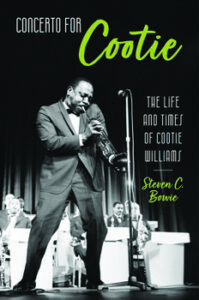 Bowie takes a brisk approach from the opening pages, covering Williams’ childhood and pre-Ellington gigs in just over 20 pages. He discusses Williams’ first decade with Ellington for 35 pages before breaking down the trumpeter’s surprising move to the Goodman organization. Bowie introduces several tidbits in the early chapters which help explain Williams’ career motives. For example, Williams prided himself on his professionalism. He was rarely late to the job and was very vocal in his criticism of Ellington’s habitually tardy sidemen. Ellington might have grown tired of the trumpeter’s frequent complaints, which would explain his unexpected cooperation in the negotiations with Goodman. The salary which Goodman promised to Williams was only slightly higher than Ellington’s current offer, but Williams had less responsibilities with Goodman and he appreciated the swinging repertoire in both the big band and the sextet. After his one-year contract with Goodman expired, Williams tried to rejoin Duke, but he was rebuffed as Ellington claimed that Williams was too popular to be a mere sideman and thus should start his own orchestra.
The history of the various Cootie Williams groups discusses the trumpeter’s early support of bebop (his band’s first theme song was Thelonious Monk‘s “Epistrophy”—recorded as “Fly Right”—and both Charlie Parker and Bud Powell held brief tenures in the Williams bands). However, it wasn’t long before Williams shifted his repertoire to Rhythm & Blues, which attracted a larger audience. While Williams continued to hire superb musicians (including Eddie “Cleanhead” Vinson and Sam “The Man” Taylor) the quality of the music began to deteriorate. On a 4-CD companion set to the book, also titled “Concerto for Cootie” (Acrobat) and sold separately, there is an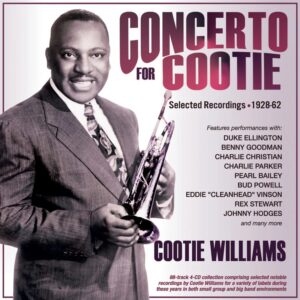 extended series of rare recordings by the Williams-led ensembles. As the set moves ahead in time, the fresh bop innovations gradually make way for repetitious R&B clichés. Acrobat is a UK-based company specializing in budget reissues of recordings made before 1962, which is the current public domain cutoff for Europe. While the legitimacy of their work can be questioned—the musicians receive no royalties—Acrobat usually does a very good job of compiling and remastering the recordings. I’m sorry to say that is not the case this time: my copy had random skips through some of the rarest tracks, and the mastering was wildly uneven with barely acceptable transfers appearing in several places. Bowie selected and annotated the tracks and I wonder why there are only two tracks with the Benny Goodman Sextet—where Williams’ muted trumpet solos were great foils to Charlie Christian‘s stunning electric guitar solos. Unfortunately, the lack of BG Sextet tracks just leaves room for more examples of the Williams band’s tiresome blues shouter Bob Merrill.
Williams returned to the Ellington band in 1962 and because of the pre-determined cut-off date, the Acrobat set only includes one example of Williams’ second tenure in the band. The true masterpiece of this period is “The Shepherd“, a portrait of Rev. John Gensel which was featured in Ellington’s Second Sacred Concert. Gensel worked with New York’s “night people” (i.e. musicians, criminals and sex workers) and their grit, anger and pain are all evident in Williams’ extraordinary plunger solo. Bowie offers a fine discussion of the song’s evolution, so it only seems fair to embed a video of the piece here. The recording was made in Sweden in November 1969.
I applaud Bowie for including Billy Strayhorn‘s quote about the difference between tune-writing and composing. Although Williams claimed that he wrote “Echoes of the Jungle” and “Concerto for Cootie“, Strayhorn’s comment notes that melodies usually submitted by Duke’s sidemen were eventually transformed and developed by Ellington and/or Strayhorn into their final recorded forms. For example, it’s hard to imagine that Williams included the 10-bar phrases in “Concerto”, especially since Ellington had written several pieces with unusual phrase lengths during the same period. In the same spirit, I wish that Bowie’s book had been edited to unify the abrupt changes of tone, wildly variant chapter lengths, and a lengthy press quote that appears twice in the same chapter. Despite my quibbles, I am glad to see that early jazz trumpeters are finally being treated to full-length biographies. With Ricky Riccardi‘s three-volume Louis Armstrong bio now available, and a long-awaited study of Frank Newton coming soon from Matthew Rivera, we could witness a renaissance for pre-bop musicians. I only hope that the publishers will allow the extra expense for good editors so that the authors and their subjects are presented in their best light.