It is always a somber task to compile the annual list of recently departed jazz musicians. More than a simple list of names, the artists represent individual voices whose unique contributions to the music are now only available on recordings. This year’s list—appearing at the end of this review–is another star-studded one. It is hard to imagine a progressive jazz scene without the creativity of Jack DeJohnette, big bands without new innovative charts by Jim McNeely, world music without Hermeto Pascoal‘s imaginative compositions, and historical research without the expertise of Larry Appelbaum. Vocal jazz took an especially hard blow this summer when three of the music’s greatest singers passed away within 19 days. All three enjoyed long careers, and they were deeply devoted to the music. Without taking anything away from the late instrumentalists, here are three Retro Reviews of extraordinary albums by Cleo Laine, Nancy King, and Sheila Jordan. (None of these recordings have been reviewed on JHO).
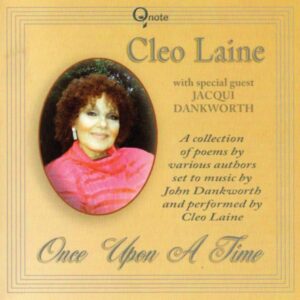
Cleo Laine’s virtuosity stretched far beyond jazz. She appeared in acclaimed stage productions of “Show Boat”, “The Mystery of Edwin Drood”, “Into the Woods” and “The Seven Deadly Sins”, and her discography includes insightful recordings of Schoenberg’s “Pierrot Lunaire” and Walton’s “Façade”. One of her greatest successes was the 1964 album “Shakespeare and All That Jazz” where she performed intricate settings of Shakespeare‘s texts to music by Arthur Young , Duke Ellington, and her husband/musical director, John Dankworth. In the late 70s, Laine and Dankworth paired new recordings of the Shakespeare pieces with more original settings of British poetry for the double LP “Wordsongs“. A 1983 live album from Carnegie Hall included even more verse settings. Laine and Dankworth celebrated the English bards on a delightful 2005 disc called “Once Upon a Time” (Q-Note 10108) which also features appearances by the Dankworth’s daughter Jacqui, and son, Alec, along with several of the family’s favorite sidemen.
The album opens with a delicious reading of “Where the Bee Sucks”, one of Ariel’s songs from “The Tempest”. The text doubtlessly sounds more sexual today than it did in Shakespeare’s time, and Laine takes full advantage, teasing us with every syllable. Laine was in her late 70s when this recording was made, and her voice was still in great shape, allowing her great accuracy through all registers of her wide range. Christopher Marlowe’s “Live with Me and Be My Love” (misattributed to Shakespeare) retains its passion through Dankworth’s gently flowing melody and Laine’s sensitive reading. Jacqui Dankworth joins Laine for a sassy “Hey Nonny No” where the immaculately blended vocals are paired with the gritty low-register violin of Paul Hart. While Laine’s first Shakespeare EP included Arthur Young’s setting of “Blow Blow Thou Winter Wind”, the text is here set by John Dankworth in a delightful arrangement which alternates between waltz and Latin styles. Laine and the quartet (John Dankworth, reeds; John Horler, piano; Alec Dankworth or Dave Olney, bass—the notes do not specify who plays when—and Allan Ganley, drums) stick with “As You Like It” for a luxurious “Under the Greenwood Tree”. “As an Unperfect Actor” appeared on “Shakespeare and All That Jazz” as an overdubbed Laine duet; here it appears on its own with a slightly adapted arrangement. Mother and daughter again combine voices for “Over Hill, Over Dale”. This famous text was delivered by the Second Fairy in “A Midsummer Night’s Dream”, but if we accept that Shakespeare’s fairy was speaking of herself and Queen Titania’s fairy band, then Dankworth’s duet setting makes perfect sense.
One of the texts on “Wordsongs” was T.S. Eliot’s “Lines to Ralph Hodgson, Esq.” Hodgson was a lesser-known poet born in the UK, who later emigrated to the US. Dankworth’s suite of five Hodgson poems was commissioned by Roger Bartley, one of the poet’s long-time friends and champions. The suite was premiered by Laine and Dankworth in Hodgson’s adopted home state of Ohio; and this album appears to be its first and only recording. As with the Shakespeare settings, Dankworth uses the Hodgson texts to lead the music, and the charts incorporate tempo and texture shifts to support Laine’s dramatic vocals. This wonderful suite is a fine introduction to an underrated poet as well as a great example of the mature styles of both Laine and Dankworth. The disc’s remaining poems include Housman‘s melancholy “Sinner’s Rue” (in a setting originally written for Jacqui), Ben Jonson‘s bacchanal “Drink to Me Only with Thine Eyes”, the all-too-wise but anonymous poem, “Methuselah” and O’Shaughnessy‘s stirring “We are the Music Makers”. The title track, composed by Laine and Horler, closes the disc. Its pacifist message remains potent two decades later.
Nancy King did not achieve the worldwide acclaim of Cleo Laine. Known as a “musician’s musician”, she spent most of her career on the West Coast, making the majority of her recordings for independent labels. Fred Hersch, King’s duet partner on the present album, first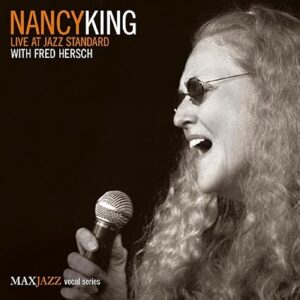 heard King on a recording made with another under-appreciated musician, pianist Art Lande. When King started to improvise on the ballad “The Nearness of You”, Hersch exclaimed to Lande, “Who is that?”. Subsequently, Hersch collected several of King’s albums, but the only time they ever spoke was on a phone call to discuss a potential recording project. That album never took place, but Hersch made up for it by inviting King to sing with him in his October 2004 Duo Invitational Series in New York. King and Hersch did not rehearse, but selected a group of familiar standards and agreed on possible approaches. Hersch had the performances recorded from the sound board without King’s knowledge. The resulting album “Live at Jazz Standard” (MaxJazz 122) is a stunning duet performance with both partners taking equal responsibility for the final results. Rather than the typical pattern of vocal chorus/piano solo/vocal chorus, King and Hersch interweave their lines, with King humming background lines under Hersch’s improvisations.
A richly-chorded Hersch intro ushers in a relaxed setting of “There’s a Small Hotel”. King breaks up the vocal line to set off the important words, and then she yields the spotlight for Hersch’s sparkling improvisation. King’s humming is barely audible here, but it seems that the engineer recognized what was happening, and he turned up King’s microphone as the set progressed. King’s solo is filled with daring register jumps and audacious inventions. The duo mines the deep melancholy from “I Fall in Love Too Easily”, with Hersch drawing strong emotions in a passionate solo. Then King creates a stunning horn-like statement where she develops motives from the original melody and her own imagination. Her recap includes some breathtaking melodic variations before returning for a spare, lonely coda. Another Sammy Cahn song “Day by Day” is combined with Charlie Parker‘s “My Little Suede Shoes” and to King’s apparent surprise, the two songs share the same chord sequence. King’s track-closing exclamation, “It works!” is my favorite non-musical moment on the album. King jumps registers throughout “Everything Happens to Me”, and somehow, she keeps the melody and solo lines intact in our minds. Hersch’s accompaniment is spare but supportive, with tasty melodic ideas linking the chords. His solo stands as a powerful romantic statement and a perfect bridge back to the vocal.
A light-hearted “Ain’t Misbehavin'” offers a rare example of Hersch’s stride piano, both behind King’s joyful solo and in his own improvisation (there are some wondrous reharmonizations in the latter choruses). The album’s highlight comes next in an exquisite 9-minute rendition of Tom Jobim‘s “Inútil Paisagem”. King’s solo extends the sorrowful mood, but as she intensifies her statement with complex lines, Hersch responds with active rhythmic backgrounds. When Hersch takes over, we can finally hear King’s hummed accompaniment underlaying his rhapsodic improvisation. The final chorus slows down as it moves towards the coda, punctuated by King’s spare reading of the final lines. The intensity is released with “There Will Never Be Another You”, taken at a medium tempo and featuring great rhythmic interplay between the two principals. Later in the track, Hersch goes deep into the harmonic maze with an astounding solo…and King keeps up with him with an astute wordless backup. At the end, King pays tribute to her late musical partner, Dave Catney. “Autumn in New York” was a natural choice considering the album’s recording date and location, and King and Hersch treat Vernon Duke‘s anthem to a timeless interpretation. After an extended piano introduction, King sings the words as if she were rediscovering them in the moment. Her understated scat solo is a perfect match for Hersch’s expansive interpretation. For the closer, King performs Jon Hendricks‘ vocalese lyrics for the Miles Davis solo on “Four”. While I’m not fond of the words—I can’t imagine Miles uttering the nonsensical rhyme, “Groovy as a Movie”—but King sings the solo with great accuracy. And as soon as she finishes, she launches into her own improvisation which acts as a fine contrast to what came before and the multi-faceted Hersh solo which follows.
 Sheila Jordan was a devoted bebopper. She started singing in public long before hearing her main inspiration, Charlie Parker, but she was fascinated with every aspect of modern jazz. Her first LP under her own name, “Portrait of Sheila” (which was also the first vocal album on Blue Note) was recorded in 1962, when she was in her mid-thirties. While the album is now considered a classic, it was not a big seller on its initial release. In her later years, Jordan was finally recognized for her creative approach to modern jazz. Her 2012 appointment as an NEA Jazz Master brought her to the attention of the enlightened public, but Jordan had collaborated with her fellow musicians on recordings for years. Because of the immense size of her latter-day discography, there is no shortage of great Sheila Jordan albums, but the album I chose, “Body and Soul” (CBS/Sony 687) was recorded before her recording activity surged. A group of CBS/Sony producers traveled from Tokyo to New York City in the autumn of 1986 with the goal of recording ten lesser-known vocalists for Japanese-issued CDs. Jordan was asked to organize the project, which naturally included an album for her. Jordan invited Shirley Horn (prior to her international success), Susannah McCorkle, Carol Sloane, Morgana King, Carmen Lundy, Lorez Alexandria, Millie Vernon, Bobbe Norris, and Vivian Lord to record, and the results were a magnificent collection of outstanding performances (the links above take you to used copies of the albums). These highly collectable albums are worth the necessary effort to obtain them (It was not always so: when I researched these albums a few years ago, I had to borrow personal copies from Jordan, Sloane and Norris, just so I could listen!).
Surrounded by a hand-picked group of musicians (Frank Wess, alto sax; Kenny Barron, piano; Harvie S, bass and Ben Riley, drums) Jordan starts her album with the title ballad, “Body and Soul”. Her elastic approach to time and melody are evident from the first chorus, and the band is a model of support and cohesion. The underappreciated Wess contributes a sensitive solo before backing up Jordan’s expressive recapitulation (which includes an extended quote from a close harmonic relative, “Prisoner of Love”). “Falling in Love with Love” opens as a bass/vocal duet, but when the band jumps in, the rise in energy is palpable. Jordan adds a sassy scat solo which makes the most of a few simple motives. Wess and Barron sparkle in their solos, and Jordan reprises a few variations from her vintage Blue Note recording. Next is Jordan’s third recording of “What are You Doing the Rest of Your Life” and this single-chorus performance could stand as a definitive version. This song is a great fit for Jordan, and she envelops the recording with a passionate delivery and sensitive melodic variations. Jordan opens “A Sleepin’ Bee” with the wonderful verse sung in rubato, followed by two choruses of the theme, both loaded with inventive melodic departures. Barron and Jordan solo over the deeply swinging rhythm, before Jordan tops her earlier choruses with a jubilant coda.
“I’m a Fool to Want You” is another holdover from “Portrait of Sheila”, but the 1986 version is an undiscovered masterpiece. Jordan understood the deep pain of the lyrics, and her plaintive wail cuts right to the heart. She emphasizes key words like “fool”, “love” and “need”, while letting the intensity slowly build up to a stunning a cappella reading of the lyric “take me back, I want you”. Barron, who is the sole accompaniment for the opening half-chorus, is in magnificent form throughout, and Riley adds delicate brushwork in the bridge and coda. “How Deep is the Ocean” is treated to a medium-tempo arrangement which somehow brings a blues feel to this Irving Berlin standard. Jordan floats over the time, followed by an urbane solo from Wess, and an incisive chorus by Barron. Jordan adds a coquettish flair to the deeply swinging and collectively improvised finale. Jordan and the band offer a version of “Lush Life” which is fine on its own merits, but doesn’t add much to what we already know about this venerable ballad. On the other hand, I love the remake of “Baltimore Oriole” with its sexy vocal, a delicious backbeat, and superb bass counterpoint. Wess takes a chorus up front on “Mood Indigo” and Jordan follows with a soulful rendition of the full song. It’s too bad that the performance didn’t continue for another chorus, but there were time considerations on these albums as they were also issued on LP. The closer is another Jordan favorite, “When the World Was Young” featuring a world-weary delivery of the lyrics, supported by solo piano on the verses and full rhythm on the choruses.
As promised, here is the list of jazz notables who left us in 2025: Larry Appelbaum, Brian Avnet, Roy Ayers, Greg Bandy, Alan Bergman, Andy Bey, Charles Burrell, Alf Clausen, Steve Cropper, Joe Daley, Francis Davis, Bob De Flores, Jack DeJohnette, Frank DeMiero, Klaus Doldinger, Ray Drummond, Roberta Flack, Paul Fontaine, Al Foster, Hal Galper, Gordon Goodwin, Bunky Green, Miles Griffith, Laurie Holloway, Anthony Jackson, Sheila Jordan, Nancy King, Tony Kinsey, Paa Kow, Cleo Laine, Prince Lawsha, Chuck Mangione, Lois Martin, Jim McNeely, Eddie Palmieri, Hermeto Pascoal, Syd Potter, Mike Ratledge, Lalo Schifrin, Jim Self, Purnell Steen, Charles Strouse, Nino Tempo, Akiko Tsuruga, Phil Upchurch, Michal Urbaniak, Ronnie Whyte, Mike Wofford.